
Chrome's two-week release cycle starts with Chrome 153
Chrome 153 begins a two-week release cycle, down from four weeks. What Google says changes, what Extended Stable keeps, and a habit worth adopting if you run forms.
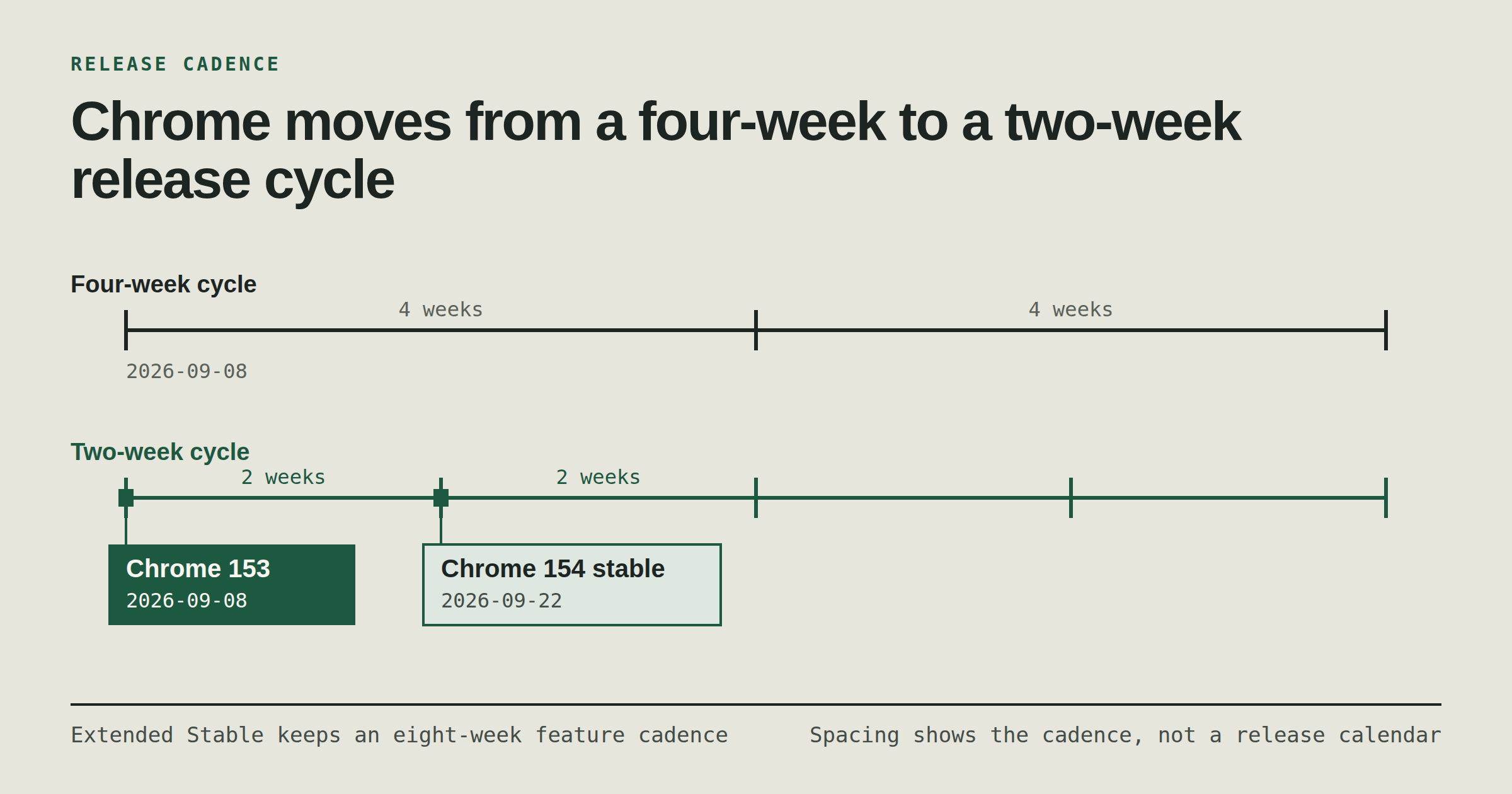
On 8 September 2026 Google announced that Chrome is moving "from a four- to a two-week release cycle", starting with Chrome 153. The announcement, "Fresher features, faster fixes: The two-week release cycle is here", is on the Chrome for Developers blog. According to Google, Chrome 153 launched that day on desktop, Android and iOS, and the four-week cycle it replaces was adopted in 2021.
What Google says changes
Google says a new Stable version will now arrive every two weeks. Chrome 154 Beta is already available for testing, and Chrome 154 Stable is scheduled for 22 September. The post makes three claims about what this means:
Features reach Stable every two weeks, with a smaller scope per release, which Google says makes regressions faster to isolate.
The two-week Stable option is, in Google's words, "the most secure choice", and Google recommends most enterprise users adopt it.
Developers should expect new features more often, bookmark the Chrome Status Roadmap, and test their sites against Chrome Beta releases.
Extended Stable keeps a slower pace
For customers who cannot accommodate a two-week cycle, Google describes an Extended Stable option. Major feature updates arrive every eight weeks, with Chrome 156 and Chrome 160 given as examples, while security fixes are still backported on the regular weekly schedule. Google tells administrators who use it to plan their test pipelines around the eight-week milestone boundaries.
What this means for anyone who runs a form
What follows is our reading, not Google's. A form is a page where a small browser regression costs you a person who was ready to write to you. If you check your forms by hand once a quarter, a two-week cycle puts roughly six Chrome versions between checks, where a four-week cycle put about three. That is arithmetic, not a measured risk; most releases will change nothing you can see. The point is that the interval between the version you last tested and the version your visitors run has got shorter, and a quarterly check no longer matches it.
A short, repeatable routine is more useful than an occasional thorough one. Every two weeks, or whenever a new Chrome Beta lands:
Open the page that holds your form in the current Chrome and in Chrome Beta.
Submit it once with valid answers, and confirm the submission arrives where you expect.
Submit it with a deliberate mistake, such as an empty required field, and read the message it shows.
Fill it in with the keyboard alone, and let the browser autofill a name and an email address.
If the form accepts a file or has several steps, repeat those paths too.
That is about ten minutes. Whichever tool builds your form, you are still testing your own page: your styles, your scripts and your tag manager sit around the form and can break independently of it.
What we are not saying
Google's post does not claim that two-week releases break websites, and neither do we. It says the opposite about scope: smaller releases, easier isolation. Whether that holds in practice is something the next few months will show. The cadence is the only certain change, and testing at the same cadence is the cheapest response.