
EN 301 549 V4.1.1 moves the European standard to WCAG 2.2
A new version of EN 301 549 references WCAG 2.2 Level A and AA. According to DWT, its main legal effect waits for citation in the Official Journal of the EU.
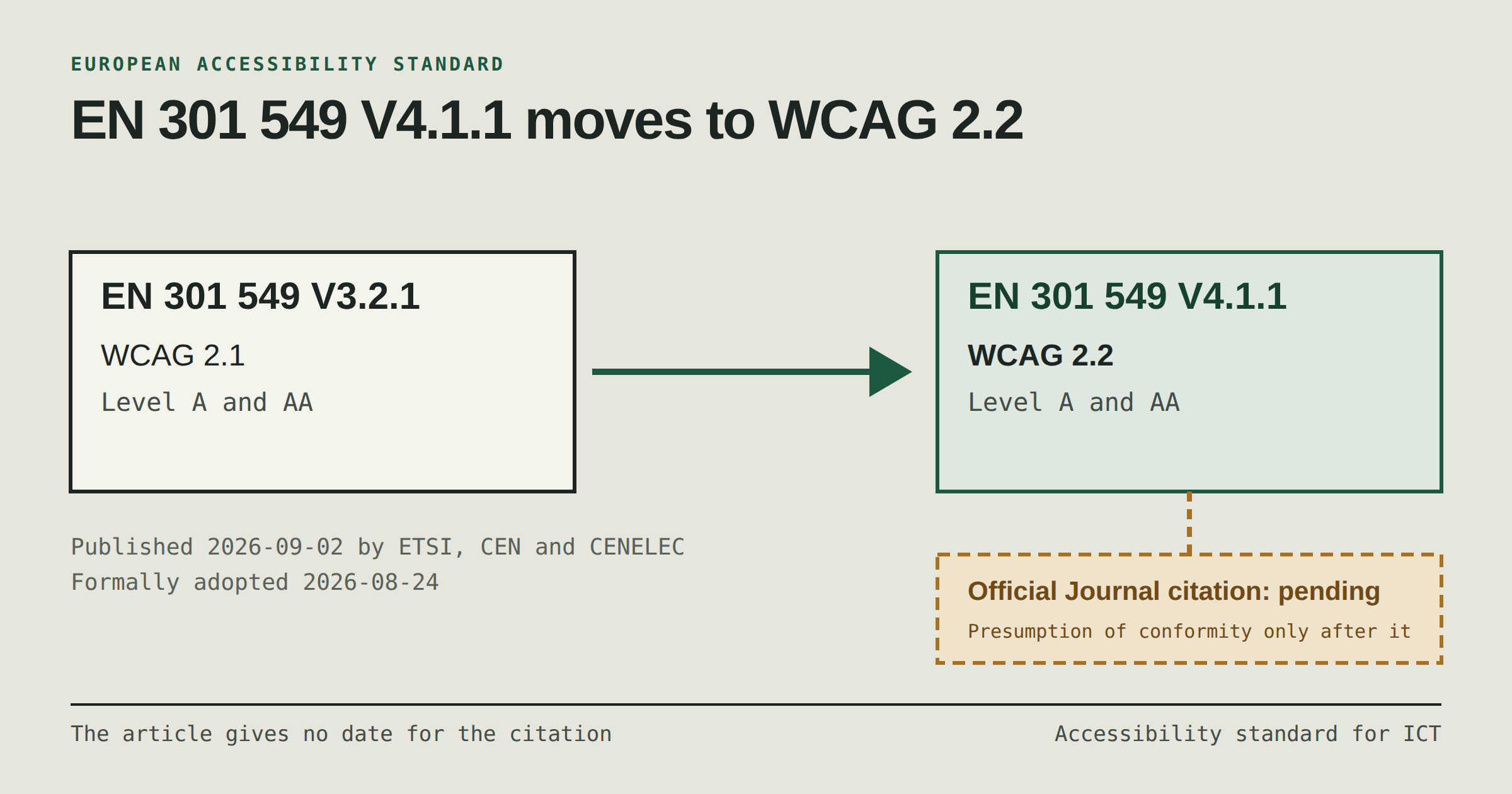
On 18 September 2026 the law firm Davis Wright Tremaine (DWT) published New Technical Standard for European Accessibility Act Compliance Released, by Brandon H. Johnson and Maria T. Browne. According to DWT, the European standards organisations ETSI, CEN and CENELEC formally adopted EN 301 549 V4.1.1 on 24 August 2026 and published it on 2 September 2026. This post summarises that article and adds nothing to its legal analysis.
What changed from V3.2.1
WCAG level. V3.2.1 tied compliance to WCAG 2.1 Level A and AA. V4.1.1 moves to WCAG 2.2 Level A and AA. DWT notes that "most other laws and regulations" still cite WCAG 2.1.
Real-time text and communications. The requirements for real-time text now cover multiparty communications, interoperability, emergency communications and "total conversation" services.
A framework for the European Accessibility Act (EAA). The standard adds a method for assessing EAA conformance, maps the EAA's essential requirements to provisions of EN 301 549 and updates the mapping for the Web Accessibility Directive. DWT calls V4.1.1 the first version of the standard to include a compliance framework built to support the EAA.
Background in brief
DWT says EN 301 549 was first published in 2014 in response to European Commission Mandate M/376, which focused on public-sector ICT procurement. The Web Accessibility Directive of 2016 later made it the main technical standard for public-sector websites and apps. The EAA, adopted in 2019, extends accessibility obligations to private-sector, consumer-facing products and services, and DWT says it became enforceable last summer. Standardisation Request M/587, from 2022, asked the standards organisations to revise EN 301 549 so it could support EAA compliance. V4.1.1 is the result.
What it does not do yet
Until then, according to DWT, V4.1.1 is an official European standard but does not carry that legal weight. We are summarising DWT; how a presumption of conformity works in a particular dispute is a question for a lawyer.
What DWT recommends
Assess WCAG 2.2 readiness. Run a gap analysis against WCAG 2.2 Level A and AA. Because many other rules still reference WCAG 2.1, some extra engineering work may be needed.
Evaluate communications offerings. Providers of communications technologies should check the revised real-time text requirements and decide whether more testing or remediation is needed.
Update compliance documentation. Review the accessibility documentation that customers and regulators often request, and update it to reference EN 301 549 V4.1.1.
Integrate the standard into governance and development. Review accessibility governance, procurement review and product development processes so they reflect the new standard.
A note on scope
Nothing here is legal advice. This post makes no claim about whether FormFlow, or any other product, conforms to EN 301 549 or to WCAG 2.2, and we would not use the word "compliant" about a product on the strength of a standard being published. The first item in DWT's list applies to almost everyone: find out which WCAG version your obligations point to, and measure your own pages against WCAG 2.2 Level A and AA, so you know the size of the gap before it is a deadline.