
The EU AI Act's Article 50 transparency rules are now in force
Article 50 applied on 2 August 2026: four transparency duties split between providers and deployers, one narrow December deadline, and guidelines that are guidance, not the Regulation itself.
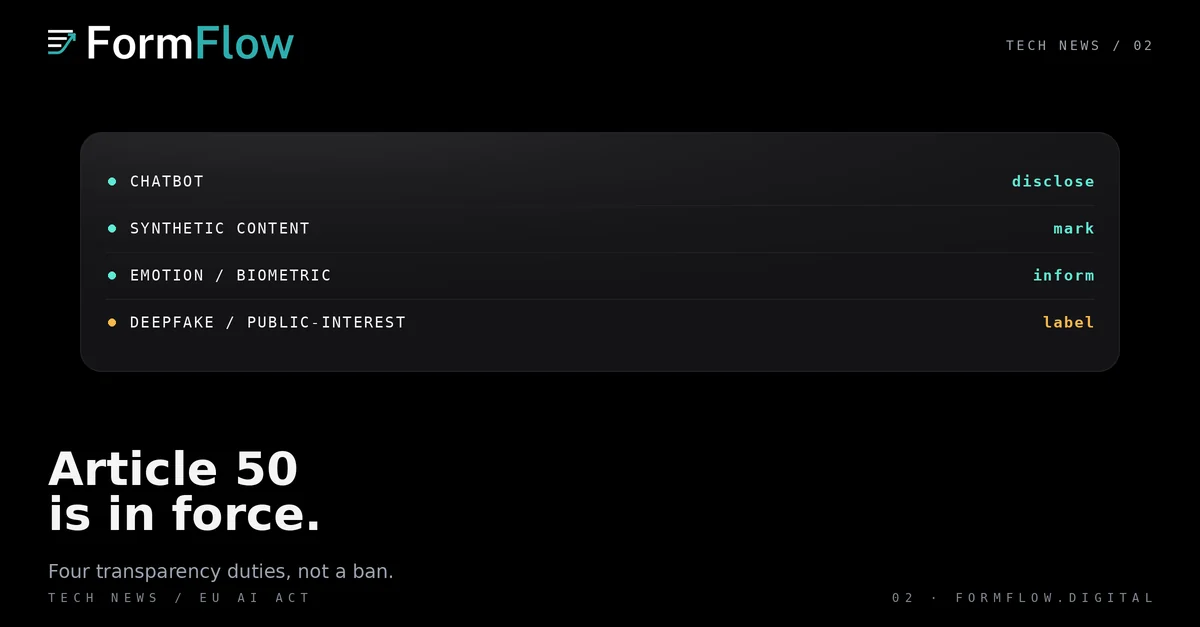
Article 50 of the EU AI Act has applied from 2 August 2026. It does not ban a use of AI; it requires that a person be told. The European Commission adopted its guidelines on the transparency obligations on 20 July 2026, and the Article itself has been in force since the start of August.
Four scenarios, two kinds of duty
Article 50 splits four scenarios between providers, who develop and place a system on the market, and deployers, who use one under their own authority.
AI that interacts directly with a person — a chatbot, a voice assistant, an agent. The provider must disclose that the person is engaging with AI, unless that is already obvious.
Systems that generate or manipulate synthetic audio, image, video or text. The provider must embed machine-readable marks and offer a detection mechanism, subject to limited exceptions such as standard editing.
Emotion recognition and biometric categorisation. The deployer must inform the people affected.
Deepfakes and AI-generated text on matters of public interest. The deployer must disclose that the content was generated or manipulated, unless a person did substantive editorial review and took editorial responsibility.
That last exception is the one most businesses can actually use. A person who edits a text and signs off on it is the difference between a disclosure duty and none.
The dates that matter
2 August 2026 — Article 50 applies, to systems already on the market as well as to new ones.
20 July 2026 — the Commission adopted its guidelines on the transparency obligations.
2 December 2026 — the end of the only transitional period: providers of generative systems already on the market have until then to comply with the marking and detection duty.
The December date is narrow, and it is easy to overstate. It covers marking and detection for generative systems already on the market. It is not a general delay for Article 50 and it does not move the disclosure duties. Content generated and published before 2 August 2026 does not have to be labelled retroactively.
What this asks of a form owner
Most Forms collect an answer; they do not produce content and they do not converse. The duties land at the two ends. If you put a chatbot on a Form to answer questions about your service, the provider of that chatbot owes the disclosure, and you should be able to point to it. If you publish AI-generated text on a matter of public interest — a policy explainer, a notice — you are the deployer, and the disclosure or the human editorial review is yours.
FormFlow's own AI surface is narrow. Build with AI drafts a Form or a Microsite for a person to edit: it produces a draft, not an autonomous publisher, and it does not put a chatbot in front of a Submitter. That is a description of what the feature does, not a compliance claim, and FormFlow does not label AI drafts for you.
What this does not decide
The guidelines are guidance, not the Regulation. They explain how the Commission reads the obligations and what evidence it expects, and they can be revised. The Code of Practice on Transparency of AI-Generated Content is voluntary: adhering to it gives a presumption of conformity for the marking and detection duties, and not adhering to it does not make a provider non-compliant — it means demonstrating equivalent means.
Nor does Article 50 settle enforcement. National market surveillance authorities, the AI Office and the EDPS enforce it, and no case law yet says what substantive editorial review or obvious means in practice. Non-compliance can reach €15 million or 3% of worldwide annual turnover, whichever is higher. Nothing here is legal advice, and a Form that meets Article 50 is not thereby compliant with the rest of the AI Act.
The two sources for this analysis are the Commission's guidelines on transparency obligations and Cooley's alert of 3 August 2026. The v1.1 post covers the Release that introduced the one-sentence builder, and its Changelog entry records what shipped.